AI
SAIDD: Symposium on AI, Data and Digitalization
Our key takeaways from the SAIDD 23 conference
SAIDD 2023
In recent times more and more organisations are getting to know and implementing big data and AI technologies in their digital transformation processes. The most valuable thing about digitalisation is that the physical world is transformed through improved productivity, innovation and impact. The possibilities with AI are many, across research, the economy and government. Given the substantial transformational scope of AI, there is potential for deep impact on the economy while also addressing regional, national and global challenges. That impact has not yet been realised, and it will depend on considerable research, development, innovation and commercial effort. To realise the possibilities of big data and AI technologies, it is essential that research and innovation in the field is supported and that we build further on the strong players already in place. New challenges and perspectives require new theory, methodology, good practice and systems, and these should be developed, shared and discussed among a wider set of relevant stakeholders.
SAIDD 2023 gave new insight into the latest trends within AI and data-driven innovation. The symposium was an arena for exchanging knowledge and experience with other professionals and companies working with AI, data and digitalisation in their research and operations. Over the two days we heard from recognised national and international experts in the field. Among them were Sören Auer, director of TIB and head of the research group at Leibniz Hannover; Kathleen M. Carley, professor of engineering and director of CASOS; Jasmien César, senior counsel for data protection for artificial intelligence at Mastercard; Virginia Dignum, professor of responsible AI and programme director at Umeå University; Fosca Giannotti, professor of computer science at Scuola Normale Superiore in Pisa, Italy; and Trym Holter, head of business development at Silo AI and former director of the Norwegian Open AI Lab.
In this post we want to share some of the content presented by the keynote speakers during SAIDD 2023.
Leveraging Cognitive Knowledge Graphs for Science and Economic Resilience
Presented by Sören Auer (Director TIB, head of the research group Data Science and Digital Libraries, Leibniz University Hannover).
Knowledge graphs are a graphical representation of a body of knowledge and information, organised in a way that makes it easy to explore and extract useful insight. A knowledge graph consists of a set of nodes representing different entities or concepts, along with edges representing the relationships between them. Knowledge graphs are often used in connection with AI and machine learning to analyse large volumes of data and draw insight from it. They can also be used in search engines and knowledge-based systems to give more precise and relevant answers to questions and queries.
In his talk, Sören Auer presented the concept of cognitive knowledge graphs, which use richer atomic base units: graphlets as constituents. This refers to a method of representing graphs by breaking them down into smaller, connected subgraphs. Auer presented the Open Research Knowledge Graph (https://orkg.org/) as an example of cognitive knowledge graphs that weave together human and machine intelligence in order to represent research contributions in a way that gives context to the research data. Each research contribution is given a structured, standardised description so that different research data can be compared and connected across fields.
As a result, ORKG provides a digital infrastructure that lets researchers and other stakeholders get a better overview of millions of publications and scholarly content.
Social Cybersecurity: Synthesizing Social Science Theory, AI and Network Science to Support Social Engagement
Presented by Kathleen M. Carley (Professor in the Public Policy Department, Computer Science Department, and Social and Decision Sciences Department, Carnegie Mellon University; director of the Center for Computational Analysis and Organizational Systems, CASOS).
Social cybersecurity is a new interdisciplinary social science that aims to characterise, understand and predict cyber-mediated changes in human behaviour and the related social, cultural and political outcomes. Cyber-mediated refers to something that happens through or by way of computer networks, the internet or digital technologies. In her talk, Kathleen Carley set out several key challenges, discussing influence operations, disinformation, bots and hate speech. She pointed to a number of empirical results from applying new social cyber technology to areas such as the COVID-19 response, the reopening of America, the election in the Philippines and other world events. In connection with those results she referred to the new Behavioural, Economic, Network, Deterrence (BEND) framework, a structured approach to analysing, assessing and responding to influence campaigns by considering behavioural, economic, network and deterrence factors. Carley went into the analytical process needed to operationalise this, along with the role of AI and network science. She presented important insights about the strengths and limitations of using AI for social cybersecurity.
Carley's research combines cognitive science, social networks and computer science to address complex social and organisational problems. Carley and her research team have developed infrastructure tools for analysing large-scale dynamic networks and various multi-agent simulation systems. A multi-agent simulation system is a computer program or model that recreates and simulates the interactions between several agents in a virtual world or simulated environment. Each agent in the system is an autonomous unit able to perceive and respond to the environment and to other agents according to certain rules and goals. Her presentation ended with a description of areas where future research will be needed to support social interaction and curb harmful online activity.
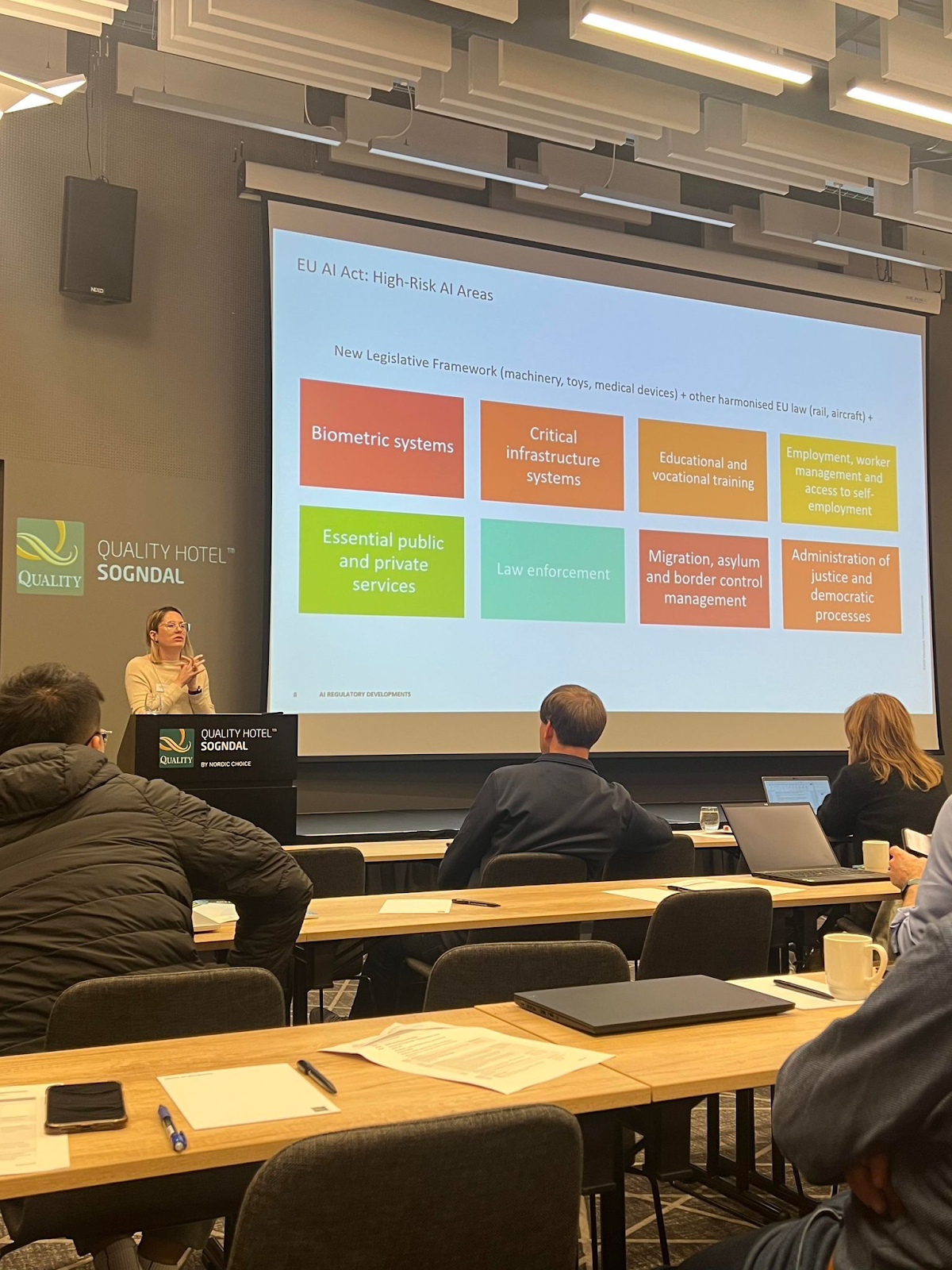
AI Regulatory Developments: Deep Dive on the EU AI Act
Presented by Jasmien César (Senior Counsel of Privacy and Data Protection for AI at Mastercard).
In April 2021 the European Commission put forward a legislative proposal to regulate the development and use of artificial intelligence in the EU. The proposal contains provisions that protect human rights and privacy while promoting growth and development within artificial intelligence. It is part of the wider digital strategy of the EU, ensuring the technology is used responsibly while keeping Europe competitive in the field. AI software has to be strong and resistant to cyber attacks, and the data used has to be of high quality. AI systems in use also have to be registered in public databases in the EU.
César also presented the risk assessments of AI made by the EU. She divides the risk into four levels: unacceptable risk, high risk, transparency risk and minimal or no risk. Social scoring, scoring the behaviour and online activity of individuals, falls under unacceptable risk. It will therefore be prohibited under the EU AI Act. Under high risk she listed biometric identification and the use of AI in hiring processes, among others. These uses will not be forbidden, but will be strongly regulated by law. Under transparency risk fall chatbots and deep fakes. Chatbots such as https://openai.com/blog/chatgpt will, under the EU AI Act, be obliged to inform the public and their users that they are communicating with a bot and that AI is in use. Uses defined as minimal or no risk will not be regulated by the EU.
Responsible Artificial Intelligence: An Inclusive Road Ahead
Presented by Virginia Dignum (Wallenberg Chair, Professor of Responsible Artificial Intelligence, Program Director WASP-HS, Department of Computing Science, Umeå University).
Artificial intelligence has great potential when it comes to adding accuracy, efficiency, cost savings and speed to a whole range of human activities, while also giving new insight into behaviour and cognition. There are major positive benefits that would serve society today. Even so, many people are sceptical about its development and implementation. The way AI is developed and implemented says a lot about how the service will affect our lives and our society. One example is that automated classification systems have on several occasions delivered biased results, which raises questions about privacy and prejudice. The impact of AI concerns not only research and development, but also how these systems are introduced into society and used in everyday situations. There is now a large ongoing debate about how the use of AI will affect work, wellbeing, social interaction, health, income distribution and other social areas. Handling these challenges requires that ethical, legal, societal and economic implications are taken into account.
In her talk, Virginia Dignum discussed how a responsible approach to the development and use of AI can be achieved, and how current approaches to ensuring the ethical alignment of decisions made or supported by AI systems can benefit from the social perspective embedded in feminist and non-Western philosophies, particularly Ubuntu philosophy. That philosophy emphasises human community, cooperation and ethical values, has previously been used as an inspiration for research work after apartheid in South Africa, and is today part of the national cultural heritage of the country.
Explainable AI (XAI): A Basic Break Towards Synergistic Human-Machine Interaction and Collaboration
Presented by Fosca Giannotti (Professor of Computer Science at Scuola Normale Superiore, Pisa, and associate at the Information Science and Technology Institute A. Faedo of CNR, Pisa, Italy).
Giannotti presented literature and work within XAI, explainable AI. She believes the future of AI lies in enabling collaboration between human and machine to solve complex problems. To achieve that requires clarity, trust and understanding. XAI makes the decision process and the results understandable to people, which is critical in high-stakes decision making. Traditionally AI uses black boxes, meaning you get a decision without an explanation of what lies behind it. Through XAI you get greater transparency, because people are told how a decision was made, allowing users to assess and validate it. That can help correct errors that lead to wrong decisions. Giannotti presented the Dr House method, a systematic approach to diagnosing the reasons behind a decision made by an AI model.
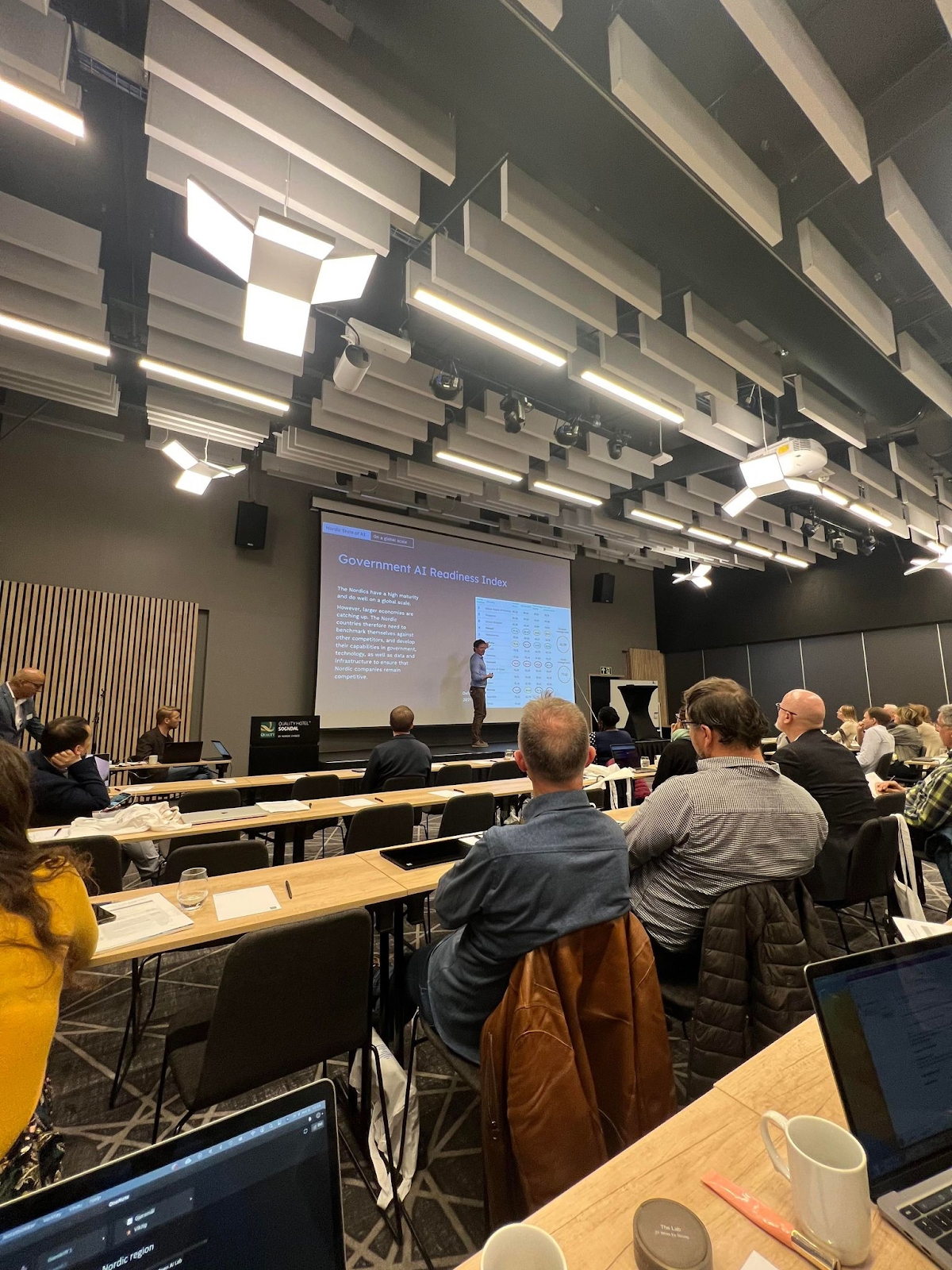
The State of AI in the Nordic Region
Presented by Trym Holter (Business Development Executive, Silo AI, and former director of the Norwegian Open AI Lab).
Trym Holter discussed the current situation for AI in the Nordic region. The focus was primarily on implementing AI technologies in the private and public sectors. Holter highlighted important barriers to and opportunities for the further development of AI-based products and services. He also underlined the importance of increased investment in AI research and development. He presented figures showing that only a quarter of companies will invest more than 20% of their R&D budget in AI. He also pointed out that a tendency in the Nordic countries is difficulty getting past the proof-of-concept phase, and that one of the biggest barriers is finding enough talent and knowledge.
The values shared between the Nordic countries are often said to help make the region one of the most innovative and competitive in the world. Although the Nordic countries are front-runners in AI readiness, ethics and trustworthiness, the region is still at an early stage when it comes to implementing AI technologies in products and services. Clearer strategies and stronger collaboration are regularly called for. Nordic governments have varying investments and strategies for accelerating the use of AI.
Thanks to the Research Council of Norway and Vestlandsforsking for the invitation to take part in the conference. If you have any questions or want to hear more, get in touch with us.