Product
What is gamification, and what can it be used for?
A short introduction to gamification and how to put it to work.
What is it, really?
Gamification is the practice of using game mechanics such as points, rewards and challenges to motivate and engage people in contexts that are not games. The concept has drawn a lot of attention in recent years, particularly in business and education, where gamification has been used to bring game-like features into real-world activities.
Building motivation
By using gamification as an element in activities, the goal is to make them more enjoyable, interactive and meaningful. The widespread use of digital devices has made the technology more accessible and more effective, and today gamification appears in many forms, such as mobile apps, websites and social media. Research shows that gamification built into digital training systems in the workplace can increase engagement by up to 50 per cent, improve learning outcomes by up to 20 per cent and boost employee motivation by up to 90 per cent.
The technology behind gamification keeps growing, and there is a wide range of potential new uses. Game elements have great potential in health and wellbeing, for example, where they can motivate people to take better care of their health by encouraging daily exercise. We have already seen examples through apps such as Zombies, Run and Fitbit.
In education, work and marketing
In education, gamification can make learning more engaging for students by introducing mechanics such as points, levels and virtual rewards. This can motivate students to work harder and support stronger learning. Game elements can also be used more widely in the workplace, where goals achieved can be rewarded through point systems, or where game-like experiences train employees in new skills. Gamification can be used in marketing to build engagement around a new brand. It can also raise environmental awareness, or drive social change, by rewarding people for making sustainable choices.
How we use gamification
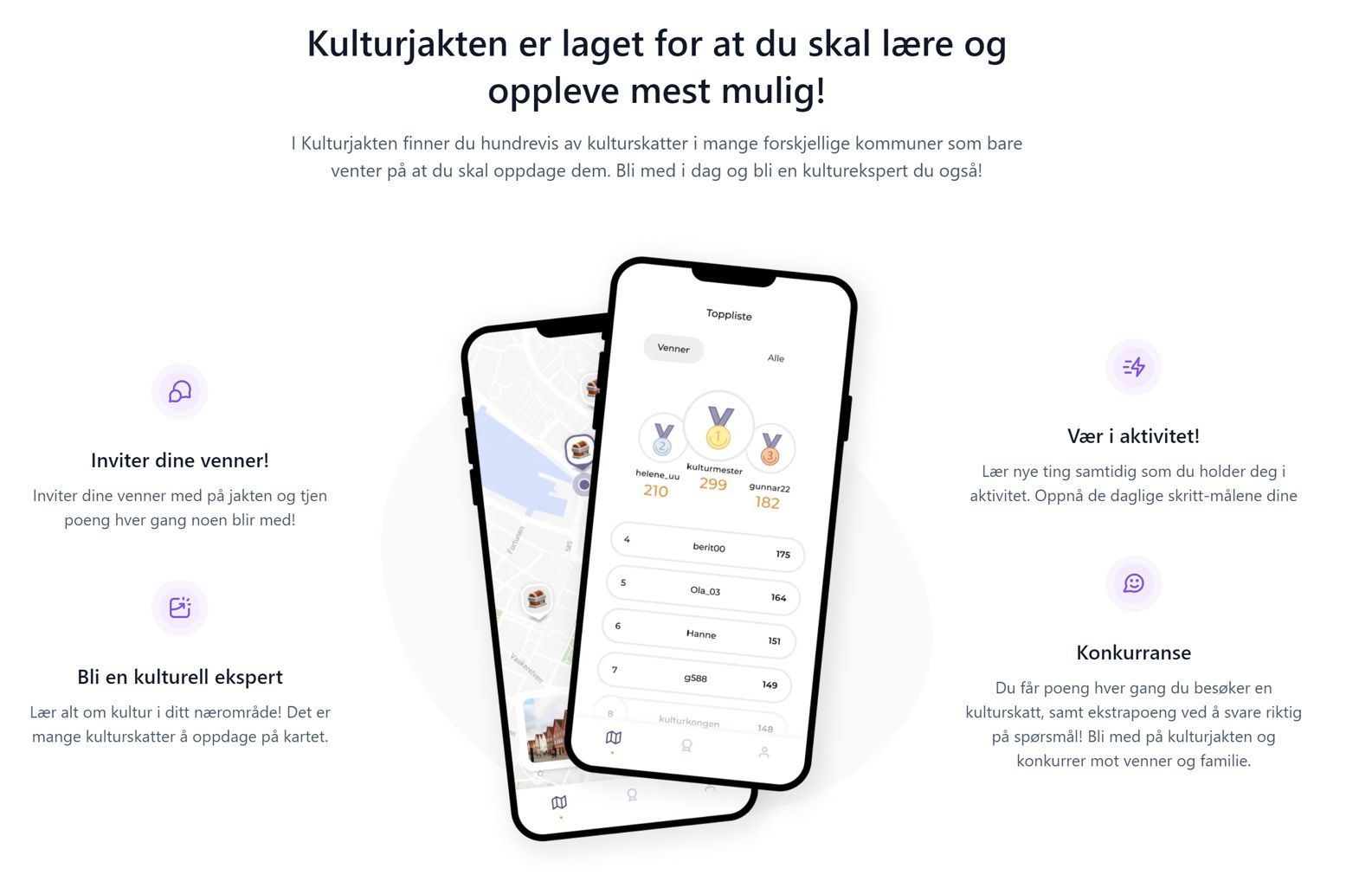
Gamification is not only useful as a motivator in the contexts above. The team at Link Utvikling has long researched and built services where gamification is a central element. Our platform Kulturjakten uses game elements to make cultural storytelling more enjoyable, more accessible and more engaging. The platform offers a points system, a built-in step counter, quizzes and a scoreboard. In this way, visiting cultural heritage sites becomes a game, where you compete against yourself and others for the highest score, all while learning more about local culture.
Gamification can be used in many different settings, and it helps increase engagement, motivation and learning. As we are in a time where technology develops very quickly, we will likely see even more interesting uses for gamification in the future.
If you would like to hear more about gamification and how we use it, just get in touch.
Written by Une Newermann and Mia Torp Nielsen